
You can know your triad shapes across the fretboard and still struggle to connect them into a chord progression. It’s common that every change feels like finding a new shape somewhere else on the neck.
The solution is to practice the chord connections and stop treating each triad as a separate diagram. Look at the three notes you’re playing, then find nearby notes of the next chord. That is the basic idea of voice leading on guitar, and we’ll use a simple C–F–G–C progression to practice it.
I’ll show you the triads and the inversions on each of the four adjacent three-string sets, with TAB for every connection. But ideally, you should already be familiar with basic major triad shapes. If those shapes still feel new, start with my guide to triads and inversions across the fretboard, then come back to this exercise.
What is voice leading on guitar?
Voice leading can be a deep and complex topic. But a simple explanation is this:
It describes how the individual notes of one chord move into the next chord.
Think of each note as its own voice. It might stay where it is, move up, or move down. Together, those small movements create the next harmony.
For this lesson, we’ll just use two guiding ideas:
- Find the nearest available notes of the next chord. Keep a shared note where you can, and move the other notes only as far as they need to go.
- Don’t simply slide the whole shape for this exercise. Look for a different inversion that lets the notes move independently.
These are practice constraints, not laws that ban you from moving a shape. Sliding an entire shape is and fun and it sounds great. But here, we want to train something else: seeing how the notes (voices) connect.
The triad inversions on guitar give you nearby option for each chord. The point of this lesson is to choose between those options by following the three voices.
Connect C, F, and G by moving the nearest notes
Let me show an example. Our I–IV–V progression in C major uses C (C–E–G), F (F–A–C), and G (G–B–D). We’ll return to C at the end so you can hear the whole connection resolve. So it’s always I–IV–V–I.
Take a C triad in root position with the notes C–E–G, from low to high. To reach F, keep the C where it is, move E up to F and move G up to A:
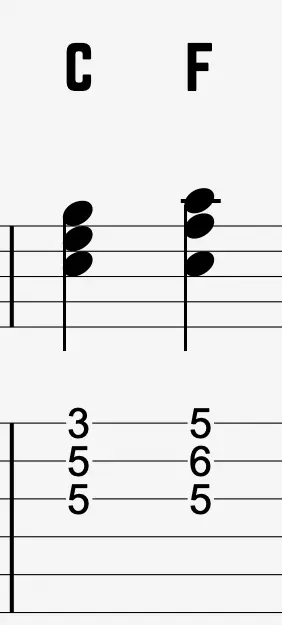
| Voice | C major | F major | Movement |
|---|---|---|---|
| Low | C | C | Stays put |
| Middle | E | F | Up one fret |
| High | G | A | Up two frets |
You’ve changed chords without searching for another shape, but by looking at the individual voices.
From that F triad (C–F–A), we can move to G as B–D–G. C drops to B, F drops to D, and A drops to G.
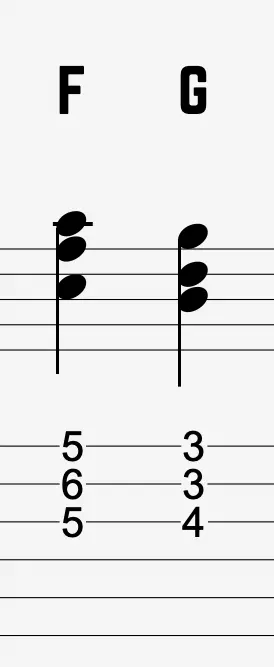
That’s the change in thinking I want you to practice. Instead of asking, “Where is another G major shape?” ask, “Where are the nearest notes of G major from here?”
Why not move the entire F shape two frets up?
You could move one F triad shape up two frets and get a G triad. The chords would be correct. But each voice would move in the same direction by the same distance, while the root remains the root, the third remains the third, and the fifth remains the fifth…so there is basically no change in structure: The F in Second Inversion turns into a G in second inversion. In traditional Music Theory this kind of movement “not allowed”.
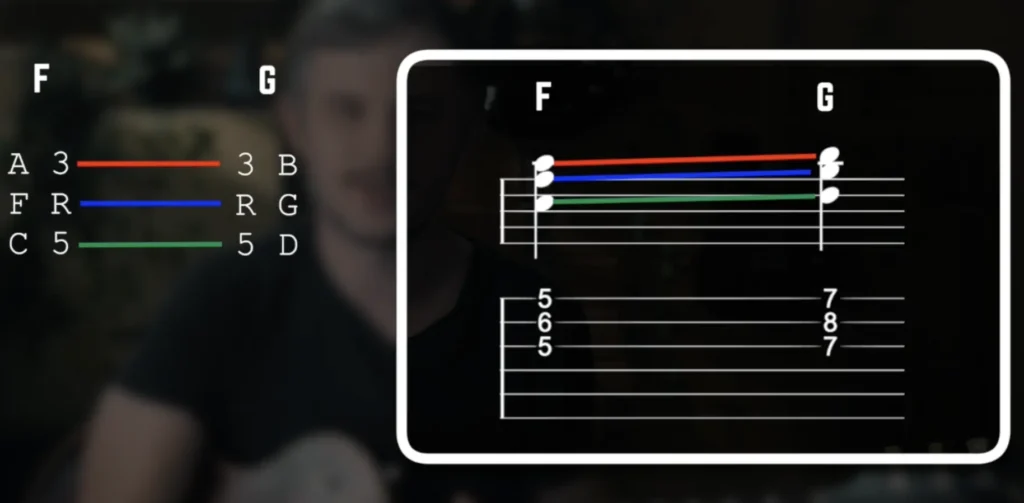
In contemporary music, that parallel movement is a sound you can absolutely use. It just doesn’t make you practice finding a nearby inversion. For the following exercise, let the individual notes choose the route.
The I–IV–V triad exercise across the fretboard
Each example below plays C–F–G–C. The first, low-position example briefly changes string sets for G; the other connections stay on the indicated three strings.
The notes shown above the TAB are chord names, not single melody notes. Strike or lightly arpeggiate each group of three notes. In most examples your fretting hand goes up toward F, down toward G, then up to C. Use that pattern to remember where to look, but follow the individual notes when you play. The open-position example changes string sets, so fret numbers alone don’t describe its movement.
1. G–B–E: the top three strings
Start with C in second inversion, using the open G and high E strings. The G chord crosses to D–G–B so that the voices can move down instead of shifting the F shape up two frets.
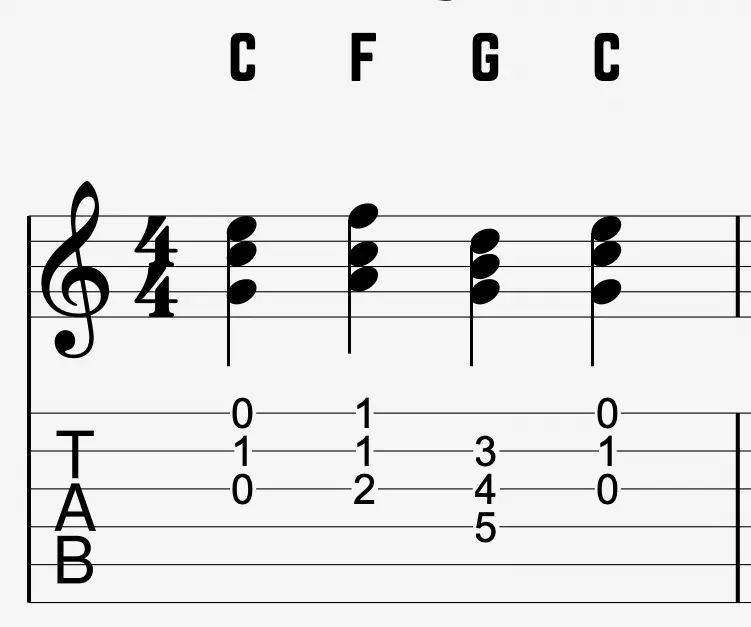
Now start from C in root position at frets 5–5–3. Here you can keep C in the lowest voice when moving to F. Then move down to a nearby G inversion and return to the original C:
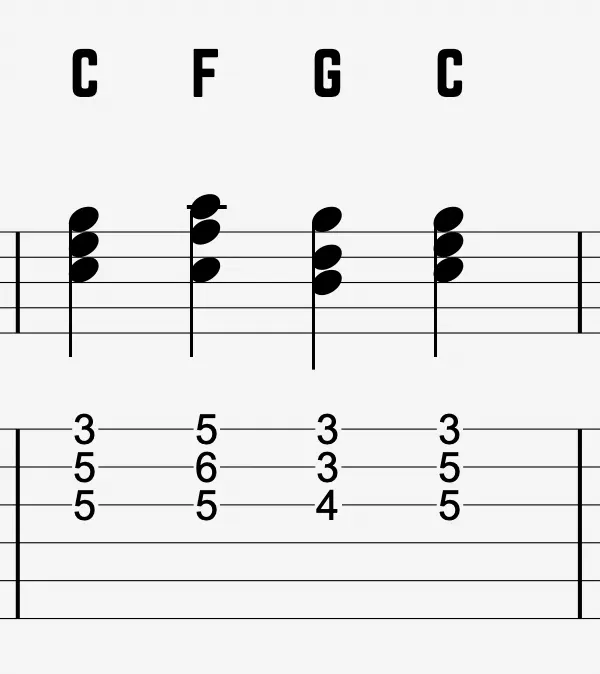
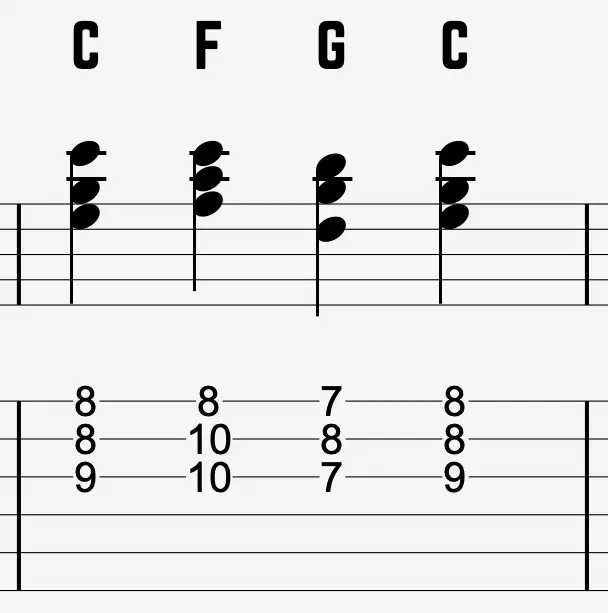
At frets 12–13–12, you have the first C shape again, one octave higher. Repeat the same idea there once the three connections above feel comfortable.
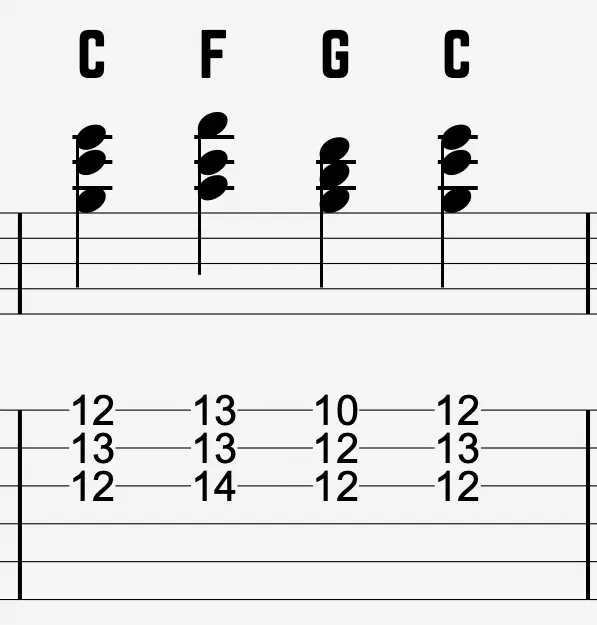
2. D–G–B: the next string set
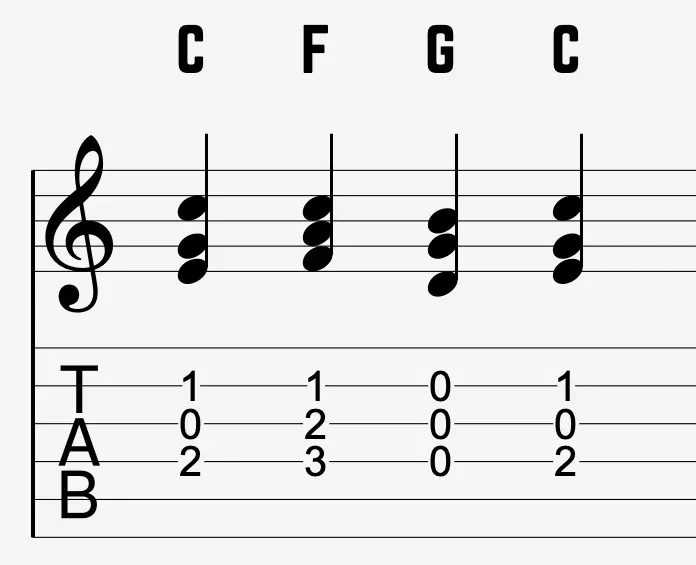
Begin with first inversion at frets 2–0–1. The top C stays put when you move to F. For G, all three voices descend by different distances; then two move and one stays as you return to C:
Start from second inversion at frets 5–5–5. As you move to F, the middle C stays where it is:
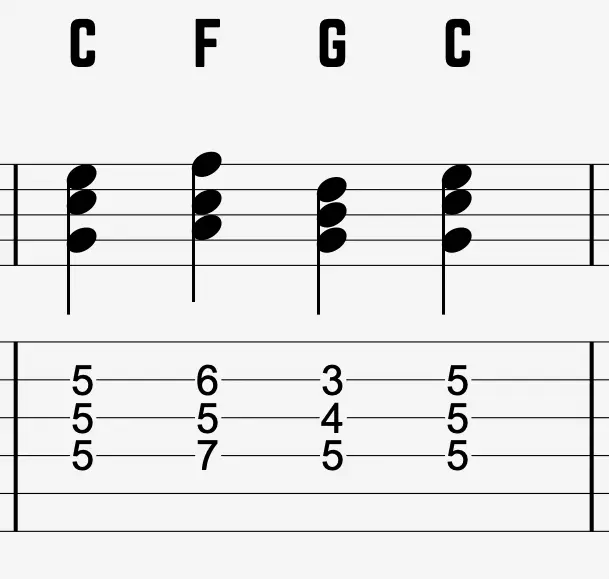
Finally, begin from root position at frets 10–9–8. Keep the bottom C for the move to F, then let each note find its way down to G:
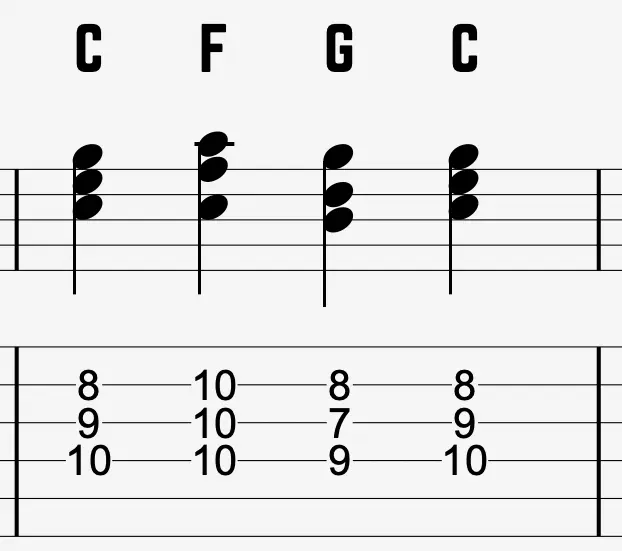
From frets 14–12–13, the first inversion begins again an octave above the open-position example.
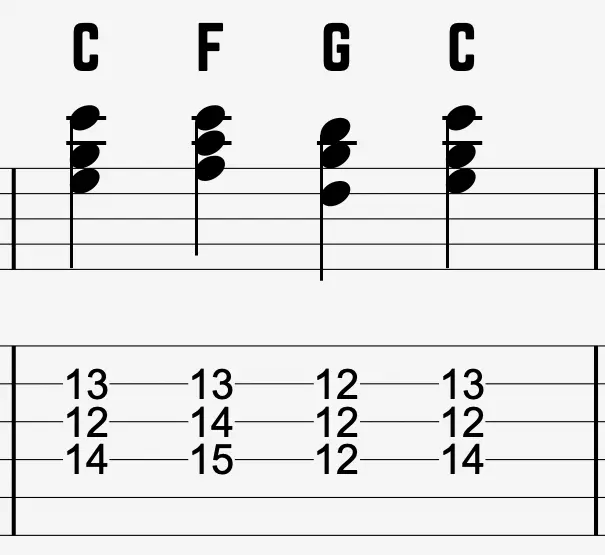
3. A–D–G: the middle-low string set
Start with C in root position at frets 3–2–0. Hold the bottom C as the other notes move up to F. The nearest G shape then sits below it:
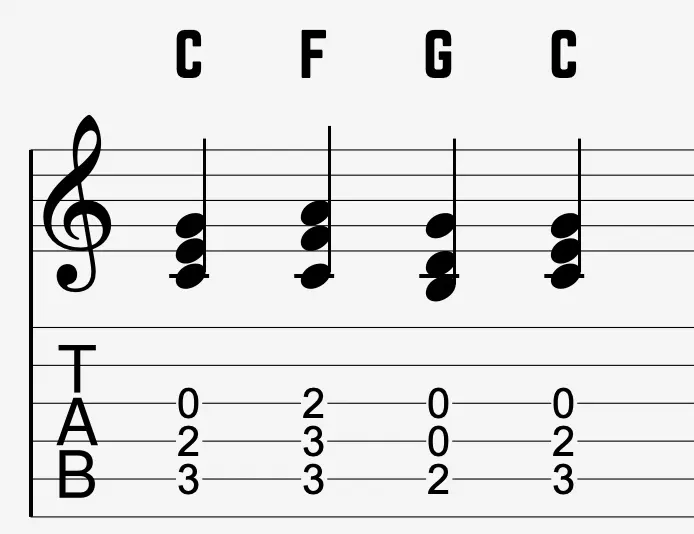
From first inversion at frets 7–5–5, the highest C can remain in place for the F chord:
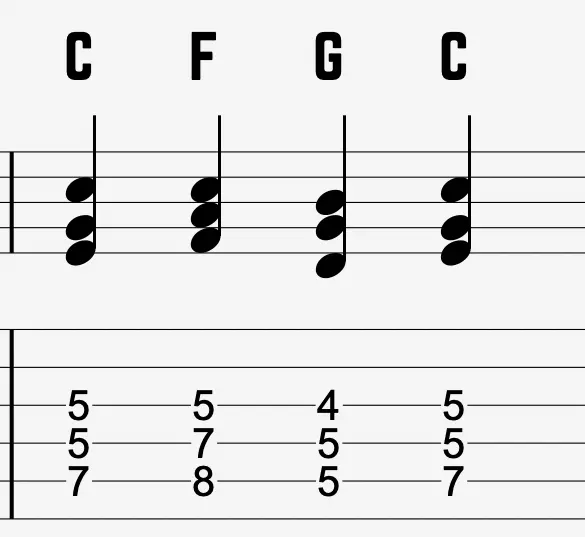
From second inversion at frets 10–10–9, the middle C stays. You may notice that the same kinds of note movements keep turning up in different parts of the neck:
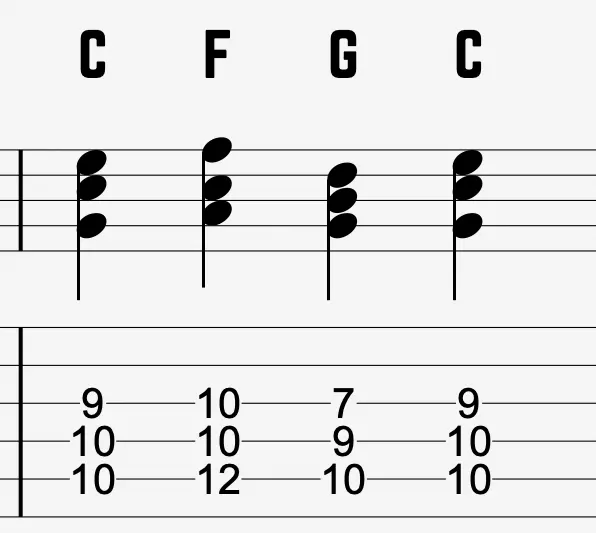
At frets 15–14–12, the root-position C returns an octave higher. You don’t need to invent a new set of connections there; you’ve reached the same shapes in the next register.
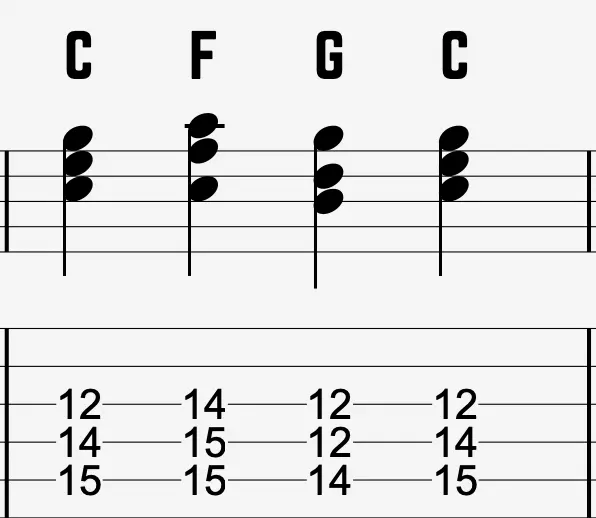
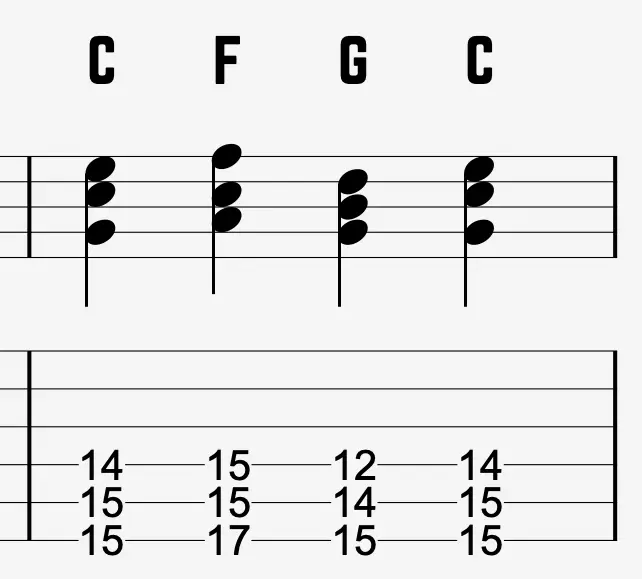
4. E–A–D: the lowest three strings
Here the starting C is in second inversion at frets 3–3–2. Keep the C in the middle voice when you move to F:
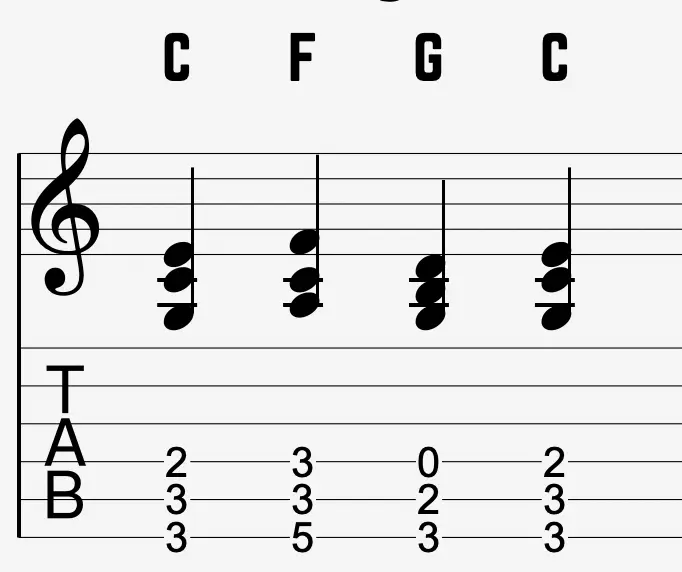
Next, begin with root position at frets 8–7–5. The bottom C stays for F, while the other two voices climb:
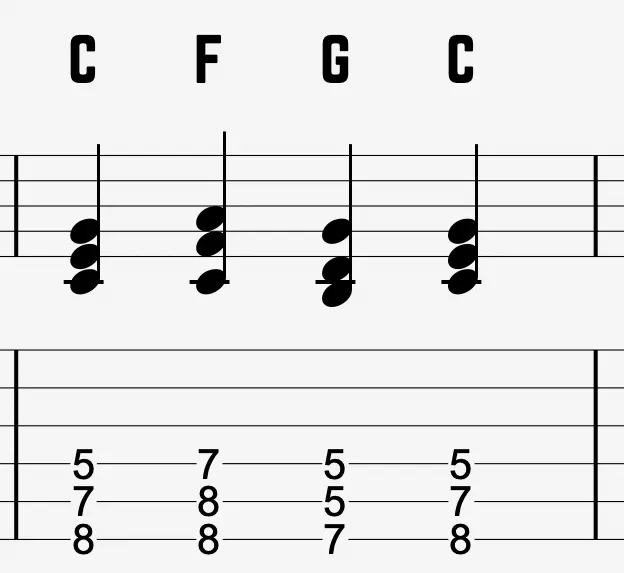
Finally, start with first inversion at frets 12–10–10. In this register, you’ll reach fret 13 for the F chord, then move back toward a lower G shape:
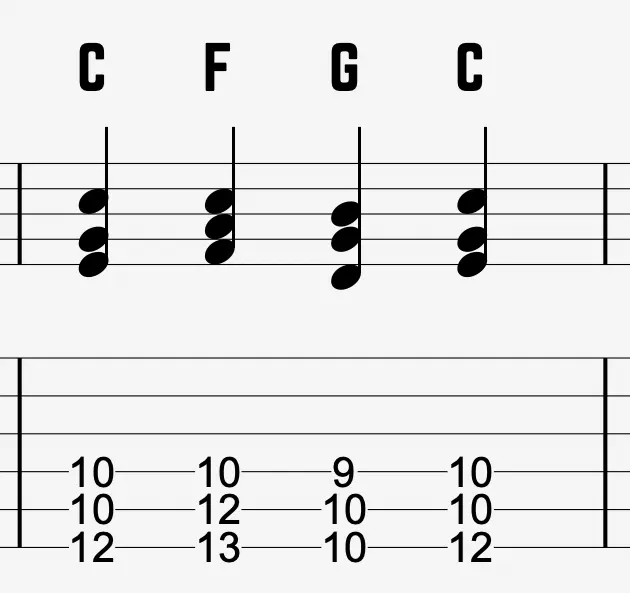
The second-inversion C returns at frets 15–15–14, an octave above our first low-string example. That completes all three starting inversions on all four adjacent string sets.
How to practice the connections
There are obviously many different ways to practice this, but I would say choose one string set and play just one C–F–G–C sequence slowly. Say the chord tones out loud, or pick each string separately while watching what happens to that voice.
Then try this without looking at the TAB: play your starting C triad, name its notes, and find F nearby. Ask which note can stay. Find G nearby from that F, then return to C. Only after you can work out one connection yourself should you move to the next inversion.
If you catch yourself shifting a familiar shape without thinking, pause and look at each note. And if a connection sounds choppy, slow down enough to hear the three little melodies inside the chords.
Once you can play the 1 4 5 1 comfortably you can try different combinations of C–F–G–C:
| Starting chord | Permutations |
|---|---|
| C | C–C–F–G · C–C–G–F · C–F–C–G · C–F–G–C · C–G–C–F · C–G–F–C |
| F | F–C–C–G · F–C–G–C · F–G–C–C |
| G | G–C–C–F · G–C–F–C · G–F–C–C |
Or you can start to play in a different key.
But first, stay with the C major triads and one I–IV–V progression. Once this makes sense, you can apply the same thinking to other keys or try minor triads and to progressions that mix major and minor chords.
Once you’re comfortable connecting C, F, and G and you want more a challenging triad exercise, try my full triad workout using the sequence of descending fifths for a longer exercise with more chords.
Have fun and stay tuned.

Frequently asked questions
Is parallel movement wrong on guitar?
No. Moving one triad shape in parallel is common and can be exactly the sound you want. Avoiding it here is a practice constraint: it makes you find other inversions and listen to the movement of the individual notes.
Do I need to know every triad inversion before trying this exercise?
No. Start with the major triad shapes on one string set. You can use the exercise to learn the other inversions as you go, though it will feel easier once the basic shapes are familiar.
What if the next two chords have no notes in common?
That’s no problem. Just look for a nearby note of the next chord for each voice.
Do I have to stay on the same three strings?
No. Most examples in this exercise stay on one string set, but the first low-position connection moves the G triad to the neighboring D–G–B strings. Follow where the notes go, even when the fingering changes strings.
Why practice voice leading with C–F–G–C?
First, The 1–4–5–1 is the most important and fundamental connection in western music. And second, you’re probably already familiar with some, if not all, of the notes. And maybe even the triad shapes… That makes it easier to focus on the underlying concept without having to learn the shapes first.
Can I use this exercise in other keys?
Yes. Once you can find the connections in C, try the same I–IV–V progression in another key, such as G major( G–C–D–G). Name the chord tones first, then find nearby inversions instead of moving every shape by memory.