
Hi friend, it’s Gregor here.
In this article, I’ll show you how to connect minor triads on guitar into 1–4–5 chord progressions across the entire fretboard. But the one-four-five progression (i–iv–v) in a minor key is a little more nuanced than it is in major. That is because there are two different but equally important versions:
Am–Dm–Em–Am (i–iv–v–i)
and
Am–Dm–E–Am (i–iv–V–i)
The good news is that these two progressions differ by just one note.
In this lesson, you’ll learn where that note comes from and how to play both versions with proper voice leading across the fretboard.
You’ll also find the TAB for every example, covering all four three-string sets.
Table of Contents
What Is a Minor Triad?
A minor triad is a three-note chord containing a root, a minor third and a perfect fifth. Its formula is 1–♭3–5. An A minor triad contains the notes A, C and E. Changing the order of those notes creates first inversion and second inversion.
The notes remain the same in every inversion. Only the note at the bottom changes:
- Root position: A–C–E (1–♭3–5)
- First inversion: C–E–A (♭3–5–1)
- Second inversion: E–A–C (5–1–♭3)
These inversions let us connect chords without jumping between distant shapes. We can look for the nearest available notes and remain in the same area of the neck.
This lesson assumes that you already know the basic shapes. If they still feel unfamiliar, begin with my lesson on basic triad shapes and inversions, then return to the progression below.
Why Are There Two Minor 1–4–5 Progressions?
There are two useful ways to look at this in music theory. We can derive the chords from a scale, or we can focus directly on the chords and their harmonic function.
I prefer the scale-based explanation because it connects scales with chords and shows us how we can use them for improvisation.
Both progressions belong to the same basic key, but they use two slightly different versions of the minor scale.
Let’s begin with the version that occurs naturally: A natural minor.
The 1–4–5 Chords in A Natural Minor
The notes of A natural minor are:
A, B, C, D, E, F and G
If we build triads on the first, fourth and fifth degrees, we get:
- i: A minor — A, C, E
- iv: D minor — D, F, A
- v: E minor — E, G, B
That gives us:
Am–Dm–Em–Am
or, in Roman numerals:
i–iv–v–i
All three chords are minor. The available scale notes determine the quality of the triads in a minor scale.
Play the progression and listen closely to the move from E minor back to A minor. It resolves, but the pull is not really that strong. The reason is found inside the E minor chord.
Its notes are E, G and B. The note G is a whole step below A, our tonic. Because that distance is a whole step, G does not create the strongest possible anticipation of A.
What Changes in A Harmonic Minor?
We can create a stronger resolution by raising the seventh degree of A natural minor from G to G-sharp:
| Scale | Notes | Seventh degree |
|---|---|---|
| A natural minor | A–B–C–D–E–F–G | G |
| A harmonic minor | A–B–C–D–E–F–G♯ | G♯ |
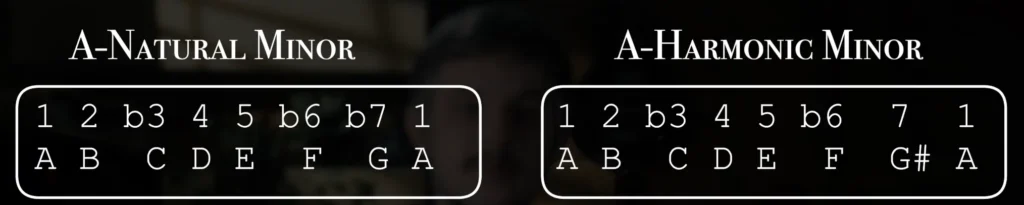
This single change gives us A harmonic minor. It also changes the five chord:
E minor: E–G–B
E major: E–G♯–B
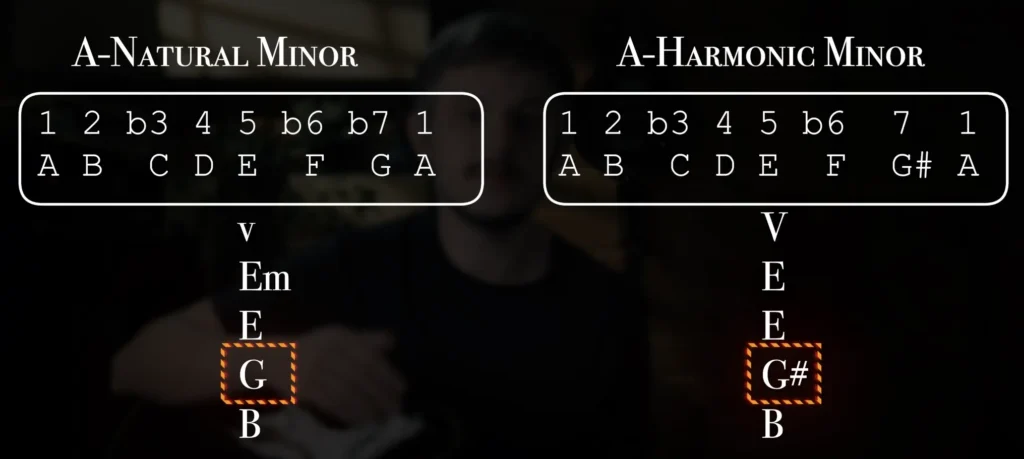
G is the minor third of E minor. Raising it to G-sharp turns that minor third into a major third, so E minor becomes E major.
Nothing changes in the A minor or D minor triads. Only the five chord changes:
Am–Dm–E–Am
or:
i–iv–V–i
Notice the uppercase V. Uppercase Roman numerals indicate a major chord, while the lowercase v in the natural-minor version indicates a minor chord.
This is the essential difference when comparing natural minor vs harmonic minor in this progression: G becomes G-sharp, and the minor v becomes a major V.
Why Does E Major Resolve More Strongly to A Minor?
G-sharp sits just one half step below A. A note one half step below the tonic is called the leading tone because it creates a strong tension & expectation that it will rise into the tonic.
Compare these two movements:
G → A: whole step
G♯ → A: half step
Now compare the complete resolutions:
Em → Am
E → Am
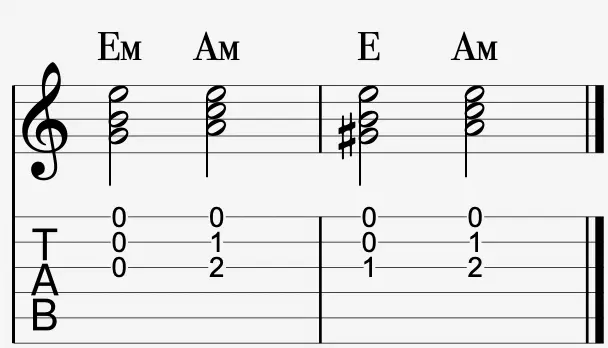
The second resolution feels stronger because G-sharp is closer to A than G. That movement is contained inside the E major chord and it’s giving the dominant a much stronger pull back to the tonic.
Both versions appear in music. The minor v gives you a light and soft transition to the tonic, while the major V creates the stronger resolution.
How to Use Voice Leading with Minor Triads on Guitar
Voice leading simply means paying attention to how each note (every note is considered a voice) moves from one chord to the next.
For this exercise, we’ll apply the same two principles I introduced in my earlier lesson on voice leading with major triads:
- Find the nearest notes of the next chord.
- Avoid moving the entire shape in parallel.
If these ideas are new to you, I recommend reading that lesson first. You can also watch the video version on YouTube.
Moving an entire shape can produce the correct chords, but it often creates unnecessary jumps. Triad inversions give us closer alternatives: one note may remain in place while the other two move only a short distance.
That is the main idea behind voice leading on guitar. Instead of seeing each chord as an isolated diagram, we follow the movement of its three individual notes.
Across the exercises below, the general movement on the fretboard remains surprisingly consistent:
Up, down, up.
We move from A minor up to a nearby D minor, down to the closest E minor or E major triad, and then back up to A minor.
All 1–4–5 Minor Triads Across the Fretboard with Guitar TAB
For every starting position, play the natural-minor version first:
Am–Dm–Em–Am
Then play the harmonic-minor version:
Am–Dm–E–Am
Only one note should change between the two versions: G becomes G-sharp inside the five chord.
The fret numbers below are written from the lowest-pitched string to the highest-pitched string within each three-string set.
String Set 1 — G, B and High E Strings
We begin on the top three strings with A minor in root position. In the first pair, the natural-minor five chord is the open E minor triad 0–0–0. For the harmonic-minor version, only the G on the third string moves up one fret to G-sharp, giving us 1–0–0.
| Starting A minor | Natural minor: Am–Dm–Em–Am | Harmonic minor: Am–Dm–E–Am |
|---|---|---|
| Root position | 2–1–0 → 2–3–1 → 0–0–0 → 2–1–0 | 2–1–0 → 2–3–1 → 1–0–0 → 2–1–0 |
| First inversion | 5–5–5 → 7–6–5 → 4–5–3 → 5–5–5 | 5–5–5 → 7–6–5 → 4–5–4 → 5–5–5 |
| Second inversion | 9–10–8 → 10–10–10 → 9–8–7 → 9–10–8 | 9–10–8 → 10–10–10 → 9–9–7 → 9–10–8 |
| Root position, octave | 14–13–12 → 14–15–13 → 12–12–12 → 14–13–12 | 14–13–12 → 14–15–13 → 13–12–12 → 14–13–12 |
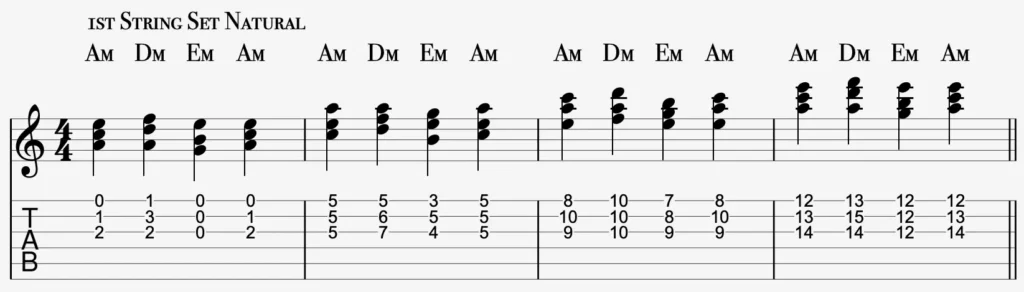
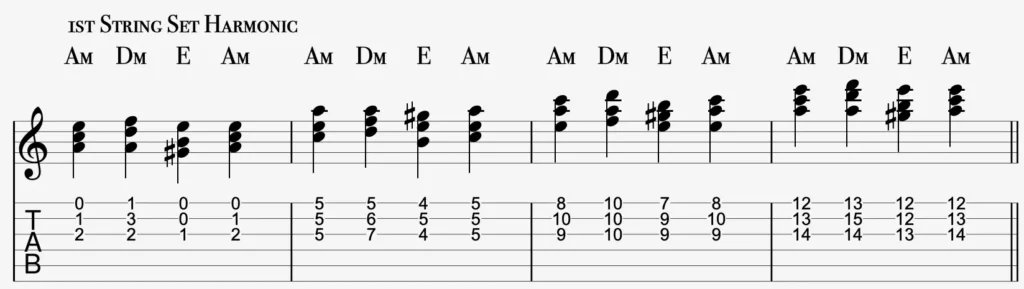
Notice the overall movement: A minor moves up to D minor, down to the five chord, and back up to A minor.
String Set 2 — D, G and B Strings
On the D, G and B strings, our lowest A minor shape begins in second inversion. The chord shapes are different, but the voice-leading principle is exactly the same.
| Starting A minor | Natural minor: Am–Dm–Em–Am | Harmonic minor: Am–Dm–E–Am |
|---|---|---|
| Second inversion | 2–2–1 → 3–2–3 → 2–0–0 → 2–2–1 | 2–2–1 → 3–2–3 → 2–1–0 → 2–2–1 |
| Root position | 7–5–5 → 7–7–6 → 5–4–5 → 7–5–5 | 7–5–5 → 7–7–6 → 6–4–5 → 7–5–5 |
| First inversion | 10–9–10 → 12–10–10 → 9–9–8 → 10–9–10 | 10–9–10 → 12–10–10 → 9–9–9 → 10–9–10 |
| Second inversion, octave | 14–14–13 → 15–14–15 → 14–12–12 → 14–14–13 | 14–14–13 → 15–14–15 → 14–13–12 → 14–14–13 |
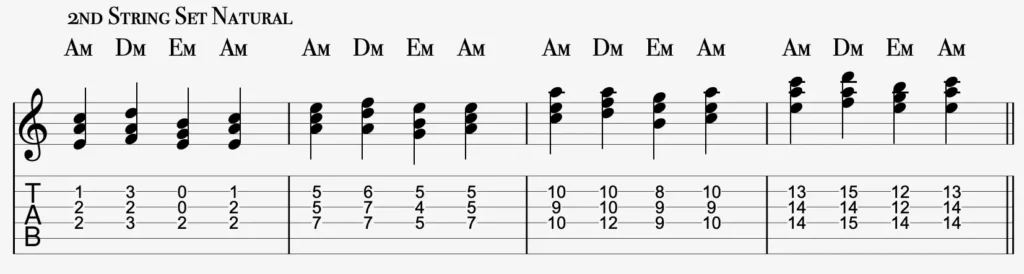
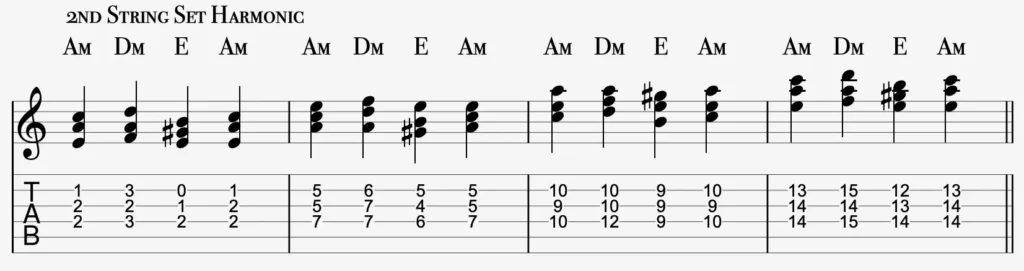
Again, compare each pair carefully. The A minor and D minor voicings remain identical. Only the note G inside the five chord is raised to G-sharp.
String Set 3 — A, D and G Strings
On the A, D and G strings, the lowest available connection begins with A minor in first inversion. From here, play each natural-minor progression and immediately follow it with the harmonic-minor version.
| Starting A minor | Natural minor: Am–Dm–Em–Am | Harmonic minor: Am–Dm–E–Am |
|---|---|---|
| First inversion | 3–2–2 → 5–3–2 → 2–2–0 → 3–2–2 | 3–2–2 → 5–3–2 → 2–2–1 → 3–2–2 |
| Second inversion | 7–7–5 → 8–7–7 → 7–5–4 → 7–7–5 | 7–7–5 → 8–7–7 → 7–6–4 → 7–7–5 |
| Root position | 12–10–9 → 12–12–10 → 10–9–9 → 12–10–9 | 12–10–9 → 12–12–10 → 11–9–9 → 12–10–9 |
| First inversion, octave | 15–14–14 → 17–15–14 → 14–14–12 → 15–14–14 | 15–14–14 → 17–15–14 → 14–14–13 → 15–14–14 |
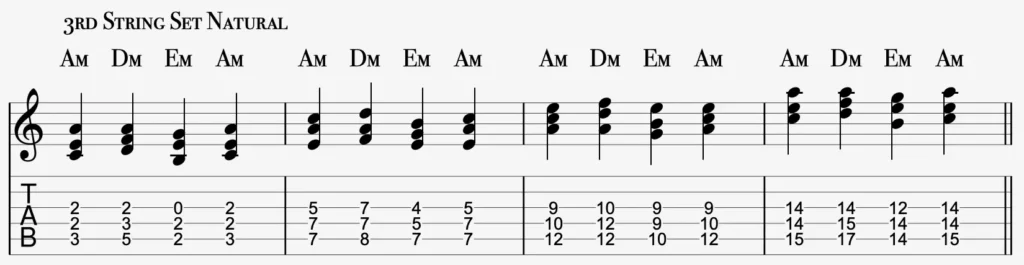
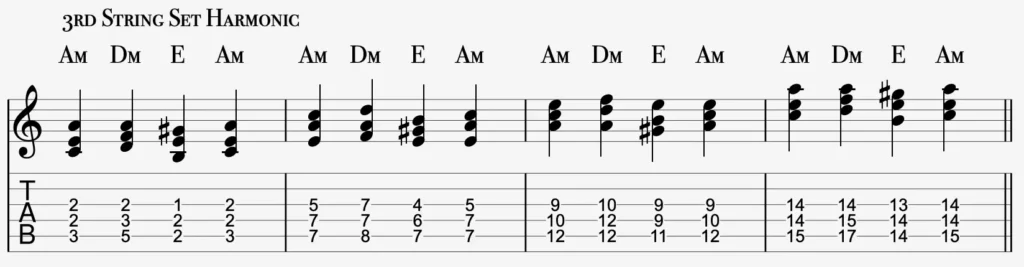
At this point, resist the temptation to think only in complete shapes. Watch the single moving note in the five chord. That small movement is what changes the harmonic function of the progression.
String Set 4 — Low E, A and D Strings
Finally, we reach the low E, A and D strings. These voicings have a fuller, lower sound, but the same sequence of inversions carries us across the neck.
| Starting A minor | Natural minor: Am–Dm–Em–Am | Harmonic minor: Am–Dm–E–Am |
|---|---|---|
| Root position | 5–3–2 → 5–5–3 → 3–2–2 → 5–3–2 | 5–3–2 → 5–5–3 → 4–2–2 → 5–3–2 |
| First inversion | 8–7–7 → 10–8–7 → 7–7–5 → 8–7–7 | 8–7–7 → 10–8–7 → 7–7–6 → 8–7–7 |
| Second inversion | 12–12–10 → 13–12–12 → 12–10–9 → 12–12–10 | 12–12–10 → 13–12–12 → 12–11–9 → 12–12–10 |
| Root position, octave | 17–15–14 → 17–17–15 → 15–14–14 → 17–15–14 | 17–15–14 → 17–17–15 → 16–14–14 → 17–15–14 |
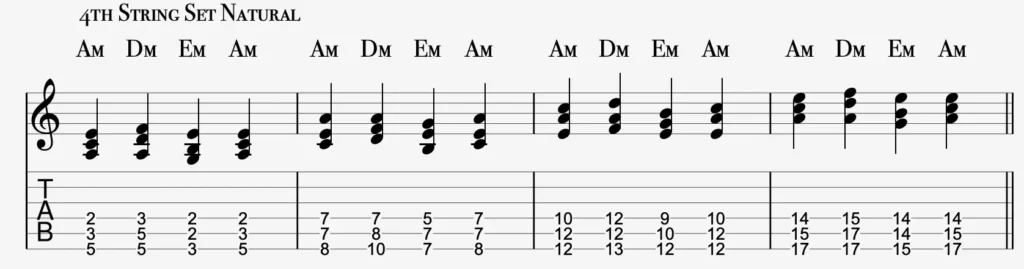
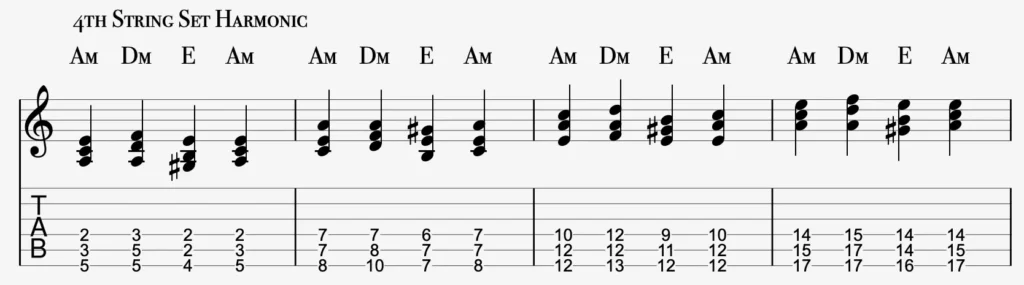
That completes the progression on all four string sets and gives you a practical chart of the minor-triad connections for both versions of the five chord.
How Should You Practice These Minor-Triad Connections?
Don’t try to memorize all four string sets at once.
Instead, use this sequence:
- Choose one string set.
- Learn only the natural-minor progression on that set.
- Add the harmonic-minor version.
- Compare E minor and E major deliberately.
- Move to the next string set only when both versions feel more or less comfortable.
Practice slowly enough that every chord sounds clean. The goal is to recognize the nearest available voicing and reach it without too much hesitation.
Later, you can experiment with arpeggiating the chords, adding different rhythms or playing along with a backing track.
If you want a longer system for learning notes, intervals, scales and triads in a logical order, you can also work through my free Fretboard Plan.
How Can You Turn These Triads Into Music?
This exercise teaches you to find and connect the chords, but the next question is more important:
How can you use these triads to make actual music?
A very practical next step is to harmonize a melody with triads. Instead of playing the progression as a chord drill, you place the melody note at the top of each voicing and choose the nearest inversion that supports it.
I have a complete lesson that walks you through that process in five steps: How to Play Melodies with Triads — A 5 Step Guide.
That is the lesson I would continue with once these natural- and harmonic-minor connections feel comfortable.
Conclusion
The two versions of the minor one-four-five progression differ by one note: G becomes G-sharp.
That single change turns E minor into E major, creates the leading tone and gives the five chord a stronger pull back to A minor. By practicing both versions you learn not only the important minor triad shapes, but also learn to really hear the harmony and the difference between minor v and major V.
Have fun and stay tuned.

Frequently Asked Questions
What is a minor triad?
A minor triad is a three-note chord built from a root, minor third and perfect fifth. Its interval formula in root position is 1–♭3–5. For example, A minor contains A, C and E. Those notes can be arranged in root position, first inversion and second inversion.
What triads are in the A natural minor scale?
The diatonic triads in A natural minor are Am, B diminished, C, Dm, Em, F and G. The one, four and five chords are Am, Dm and Em, giving us the progression i–iv–v.
What is the difference between natural minor and harmonic minor?
Harmonic minor raises the seventh degree of the natural minor scale by one half step. In A minor, G becomes G-sharp. This creates a leading tone below A and changes the five chord from E minor to E major.
Why is E major used in the key of A minor?
E major contains G-sharp, the leading tone of A minor. G-sharp sits one half step below A and creates a strong pull into the tonic A minor. The chord can be related to the A harmonic minor scale.
Is the five chord major or minor in a minor key?
It can be either. The natural minor scale produces a minor five chord, written v. Raising the seventh scale degree creates harmonic minor and produces a major five chord, written V. Both sounds are useful and common.
Why is voice leading on guitar important?
It helps you to think more deeply about chord voicings so that you can play more intentionally. Voice leading is the way each individual chord tone moves into the next chord. On guitar, good voice leading usually means choosing nearby inversions, retaining common tones where possible and avoiding unnecessary jumps around the neck.
How should I practice minor-triad inversions?
Choose one three-string set and learn root position, first inversion and second inversion in one key. Then connect those inversions through a real progression. Stay with that string set until the movement feels comfortable before adding another one.